


Page 6 - Wayne Dispatch Pages
P. 6
Wayne should consider


          a Historic District


             Although  Wayne  is  small  and  a
          large   part   of   its   historic
          buildings  were  torn  down  in  the
          1960s during Urban Renewal, there
          are still some historic gems left that
          should be protected. Designating an
          area a Historic District is one of the
          few ways to legally protect an area
          from  destruction,  and  ensures  the
          area is preserved for future genera-
          tions.                             goal is to keep an appropriate and
             The  area  along  Brush,  Clinton  historic look from the street, while
          and Elizabeth is an example of an  allowing freedom in the other areas.
          area that could be designated, as it  If you live in a historic home, it’s
          has  the  highest  percentage  of  pre-  because you like that old look and
          1900 homes left in the city. Another  character, so the goal is to preserve
          great area would be the tree streets,  that look along the street for all to
          as they have many 19s and 20s bun-  enjoy.
          galows and cottages, many of which    Most  modern  Historic  Districts
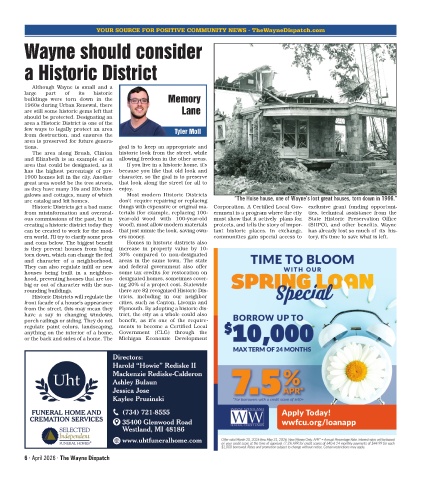
          are catalog and kit homes.         don't  require repairing or replacing     “The Hoise house, one of Wayne’s lost great houses, torn down in 1966.”
             Historic Districts get a bad name  things with expensive or original ma-  Corporation. A Certified Local Gov-  exclusive  grant  funding  opportuni-
          from misinformation and overzeal-  terials (for example, replacing 100-  ernment is a program where the city  ties,  technical  assistance  from  the
          ous commissions of the past, but in  year-old  wood  with  100-year-old  must show that it actively  plans for,  State  Historic  Preservation  Office
          creating a historic district today they  wood), most allow modern materials  protects, and tells the story of impor-  (SHPO), and other benefits. Wayne
          can be created to work for the mod-  that just mimic the look, saving own-  tant  historic  places.  In  exchange,  has already lost so much of  its  his-
          ern world. I'll try to clarify some pros  ers money.                  communities gain special access to  tory, it’s time to save what is left.
          and cons below. The biggest benefit   Homes in historic districts also
          is  they  prevent  houses  from  being  increase  in  property  value  by  10-
          torn down, which can change the feel  30%  compared  to  non-designated
          and  character  of  a  neighborhood.  areas  in  the  same  town.  The  state
          They can also regulate infill or new  and  federal  government  also  offer
          houses  being  built  in  a  neighbor-  some tax credits for restoration on
          hood, preventing houses that are too  designated homes, sometimes cover-
          big or out of character with the sur-  ing 20% of a project cost. Statewide
          rounding buildings.                there are 82 recognized Historic Dis-
             Historic Districts will regulate the  tricts,  including  in  our  neighbor
          front facade of a house's appearance  cities, such as Canton, Livonia and
          from the street, this may mean they  Plymouth. By adopting a historic dis-
          have  a  say  in  changing  windows,  trict, the city as a whole could also
          porch railings or siding. They do not  benefit,  as  it’s  one  of  the  require-
          regulate  paint  colors,  landscaping,  ments to become a Certified Local
          anything on the interior of a home,  Government  (CLG)  through  the
          or the back and sides of a home. The  Michigan  Economic  Development


          6 · April 2026 · The Wayne Dispatch

